


Important information:
Am 10. April 2024 wurden das Kundenportal sowie der Web-Zugriff auf das Kartenkonto eingestellt. Bitte laden Sie die Swiss Bankers App herunter, um weiterhin uneingeschränkten Zugriff auf alle Dienste zu haben.
Are you a Swiss Bankers sales partner?
Hier geht es zum Partnerportal.
Namibia is often described as ‘Africa for beginners’ – and for good reason. The country is easy to explore independently, the infrastructure is good, and many of the most spectacular landscapes can be reached by hire car. Yet the first impression could hardly be more rugged: endless expanses, dusty tracks and massive sand dunes, with not a single house in sight for kilometres on end. In this article, we’ll show you the best stops, experiences and travel tips for an unforgettable road trip.
 30.09.2026
 Miryana
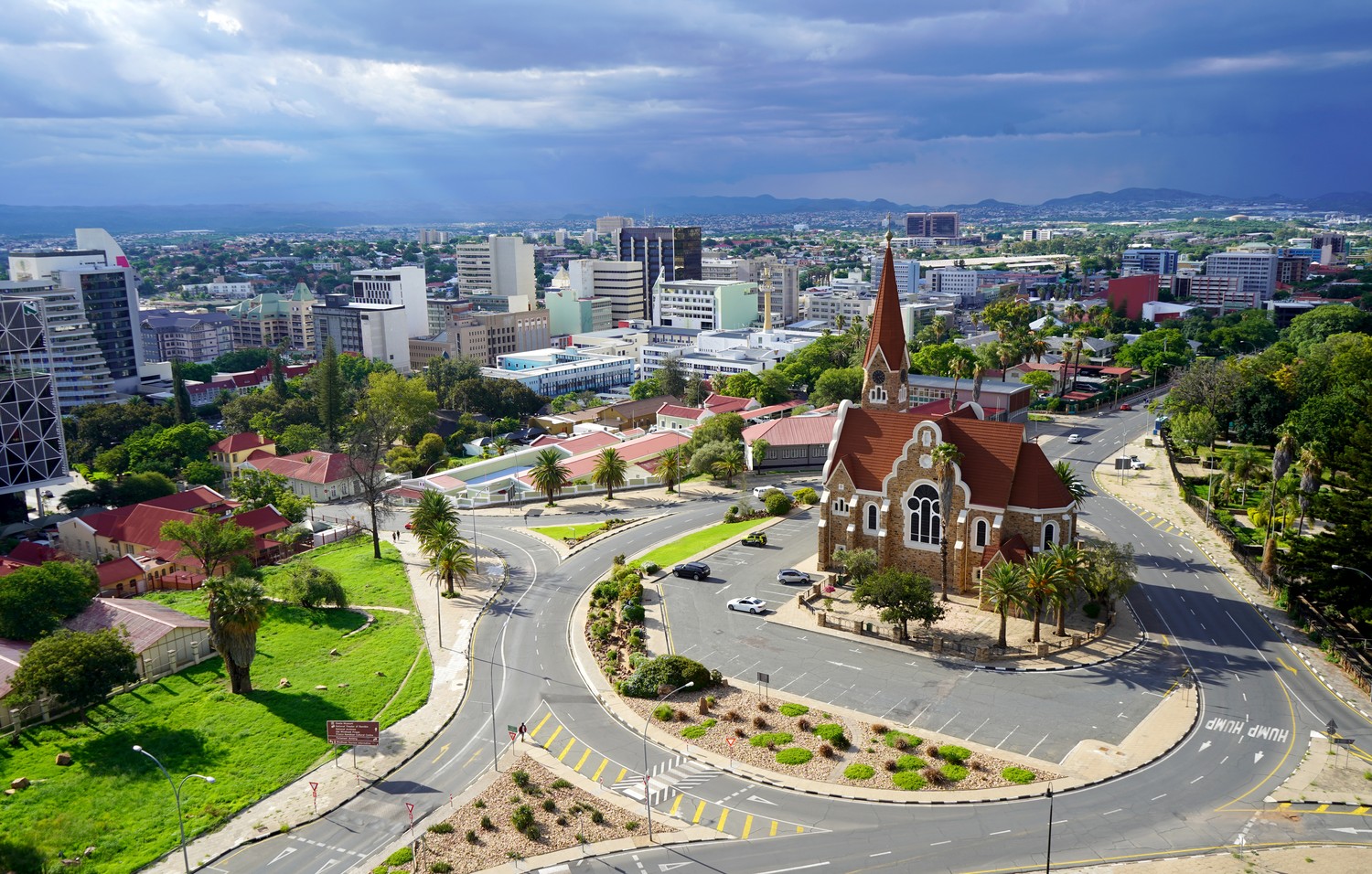
Photo: The striking Christuskirche is one of Windhoek’s best-known landmarks.
From Switzerland, the easiest way to reach Namibia is via Windhoek. Edelweiss operates seasonal non-stop flights from Zurich to the Namibian capital. You can pick up a hire car straight away at the airport. A vehicle with good ground clearance is recommended; for longer road trips, a 4×4 offers added comfort. Driving is on the left-hand side of the road.
Good to know: Swiss nationals require a visa. This can be applied for online in advance or obtained on arrival as a visa on arrival.
Route at a glance: For the route Windhoek → Spitzkoppe → Swakopmund → Walvis Bay → Sesriem/Sossusvlei → Windhoek, you should allow at least 8 to 10 days. The individual journeys usually take between two and five hours – often longer on gravel tracks and with photo stops.
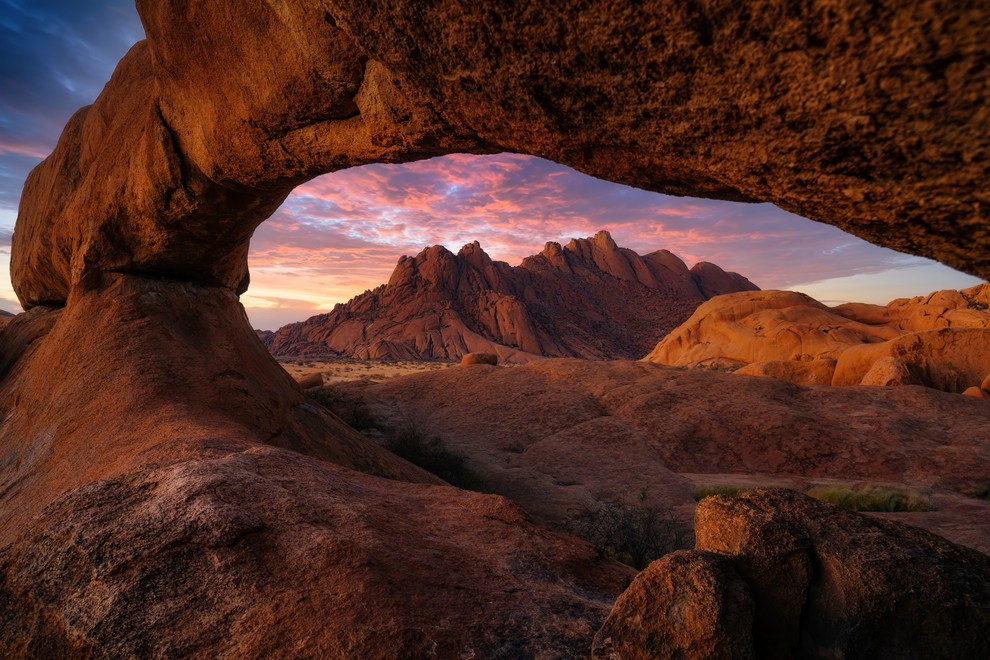
Rising up from the flat desert landscape, Spitzkoppe boasts striking granite rocks, natural stone arches and sweeping views. The area is fenced off and there is an entry charge. Admission and camping fees are paid directly at Spitzkoppe Rest Camp. It is particularly lovely to spend the night here. Spitzkoppe Rest Camp offers simple camping pitches right amongst the rocks. There are dry toilets at the campsites; hot showers and other toilet facilities are located at reception. Those who prefer a bit more comfort will now also find glamping accommodation and a separate lodge.
In the evening, it grows quiet, and an impressive starry sky unfolds above the granite rocks. Thanks to the minimal light pollution, the Milky Way can be observed particularly well here – a night under the open sky is one of the special experiences of a trip to Namibia.
The next morning, it’s well worth taking a walk to the famous Rock Arch, which glows in warm shades of red and orange, particularly at sunrise.
Video: Cape Cross – Namibia’s spectacular fur seal colony.
From Spitzkoppe, the journey continues towards the Atlantic – into a landscape that could scarcely be more rugged. Cold coastal mist, endless expanses of gravel and sand, and the roaring surf characterise the Skeleton Coast, which owes its name to the numerous shipwrecks and bones that were once left behind on this hard-to-reach stretch of coastline. The Skeleton Coast Park itself stretches from the Ugab River some 500 kilometres north to the Kunene River.
A particularly impressive stop is the Cape Cross Seal Reserve. This is home to one of the world’s largest breeding colonies of South African fur seals. According to the Namibia Tourism Board, up to 210,000 animals can gather on the coast during the breeding season in November and December. A wooden jetty allows visitors to observe the animals at close quarters.
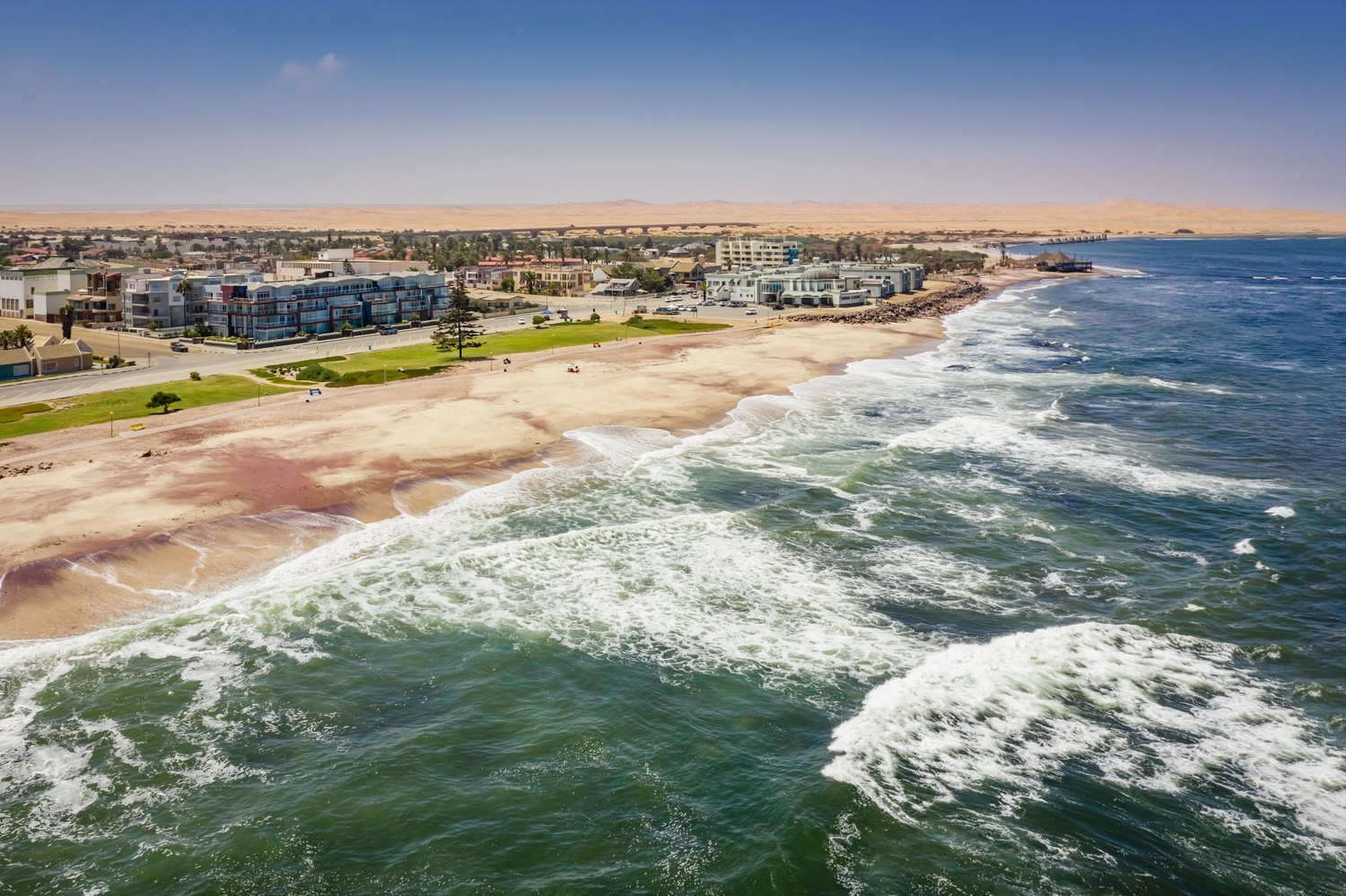
Photo: Swakopmund’s Atlantic coast – where the Namib meets the South Atlantic.
Nestled between the rugged Atlantic Ocean and the dunes of the Namib lies Swakopmund – a laid-back coastal town with promenades, cafés, restaurants and striking German colonial architecture. The town was founded in 1892 as a port for German South-West Africa. To this day, historic buildings serve as a reminder of that era. The German architecture also evokes the colonial period from 1884 to 1915 – a defining yet difficult chapter in Namibian history. The German influence is also still evident in the local cuisine: many restaurants and breweries feature German dishes, cakes and beer on their menus.
For dinner with a view of the Atlantic, we recommend The Tug Restaurant, situated right on the promenade. The restaurant is best known for its fresh fish and seafood – a particularly lovely spot at sunset. You’ll find German breads, pastries and delicatessen items at Raith’s Bakery & Deli. For coffee, light bites and unique souvenirs, it’s well worth stopping off at The Trading Post.
Hotel tip: The Strand Hotel is situated right on the historic pier and offers rooms with views of the Atlantic Ocean, as well as several restaurants and terraces by the sea.
Swakopmund is also regarded as Namibia’s adventure hub. Quad bike tours, sandboarding and scenic flights over the Namib are particularly popular. You should allow at least two nights in the town before continuing on to Walvis Bay and Sandwich Harbour.
Video: Sandwich Harbour – where the dunes meet the Atlantic.
Walvis Bay lies just around 35 kilometres south of Swakopmund. The town itself is best known for its harbour, but right next to it lies one of the most fascinating natural landscapes on the Namibian coast. Numerous waterbirds can be spotted in the vast lagoon – the large flocks of flamingos are particularly famous. The lagoon is one of the most important wetlands in southern Africa.
The real highlight, however, lies further south: Sandwich Harbour. Here, the mighty dunes of the Namib meet the Atlantic Ocean head-on – in some places there seems to be barely any space left between the sand and the sea. The area forms part of the Namib Sand Sea UNESCO World Heritage Site. The most impressive way to experience Sandwich Harbour is on a guided 4×4 tour. The journey takes you across deep sand and steep dunes and should not be undertaken on your own. The Namibia Tourism Board strongly recommends guided tours for challenging off-road routes.
If you have a little more time, you can combine your visit with a boat trip through the Walvis Bay Lagoon – with a bit of luck, you might spot seals, dolphins and pelicans.
On the way from the coast towards Sossusvlei, it’s worth making a brief stop in Solitaire – a tiny desert settlement with a petrol station and a bakery. After that, the landscape becomes increasingly spectacular until the huge red dunes of Sossusvlei come into view.
Sossusvlei is a pale salt and clay pan, surrounded by some of the highest dunes in the Namib. Dune 45 and the approximately 325-metre-high Big Daddy are particularly well known. Early in the morning, the dunes are particularly impressive. Just a few kilometres away lies Deadvlei – an almost white clay pan where dark, dead camel thorn trees stand against the backdrop of the red dunes. Some of these trees are estimated to be around 900 years old. From the starting point, a footpath about 1.1 kilometres long leads through the sand to this surreal-looking landscape.
Tip: It is around 60 kilometres from Sesriem to Sossusvlei. Anyone wishing to experience the dunes as early as possible should therefore stay overnight in or near Sesriem. The Sossus Dune Lodge is situated within the park and offers its guests particularly early access to the dune landscape. For campers, the Sossus Oasis Camp Site is a convenient alternative near the park entrance.
Just a few kilometres from the entrance to Sossusvlei lies Sesriem Canyon – a surprisingly narrow gorge in the midst of the open desert landscape. Over millions of years, the Tsauchab River has carved its way deep into the rock, forming cliffs up to around 30 metres high.
A short walk leads down into the canyon, where it is noticeably cooler than in the surrounding desert. Depending on the water level, parts of the gorge can be explored on foot. The warm light in the early morning or late afternoon is particularly beautiful as it filters through the steep rock faces.
Sesriem Canyon can be perfectly combined with a visit to Sossusvlei and Deadvlei, offering yet another, completely different perspective on the Namib-Naukluft National Park.
Namibia is a land of contrasts: red dunes, the rugged Atlantic coast, endless expanses and nights under a spectacular starry sky. It is precisely this blend of adventure and good infrastructure that makes the country so special.
In the next instalment, the journey continues to Damaraland and Etosha National Park – to rocky landscapes, desert elephants and unforgettable wildlife sightings.

© Swiss Bankers 2026


 Compare cards and conditions

