


Important information:
Am 10. April 2024 wurden das Kundenportal sowie der Web-Zugriff auf das Kartenkonto eingestellt. Bitte laden Sie die Swiss Bankers App herunter, um weiterhin uneingeschränkten Zugriff auf alle Dienste zu haben.
Are you a Swiss Bankers sales partner?
Hier geht es zum Partnerportal.
Hanoi is a city full of contrasts: in the narrow alleyways of the old town, motorbikes, small food stalls and traditional shops jostle for space, whilst just a few steps away, temples, lakes and colonial buildings create a completely different atmosphere. Join us as we explore Hanoi’s finest aspects – from well-known sights and culinary highlights to tips on the best time to visit, getting around and budgeting.
 08.09.2026
 Miryana
Hanoi is brimming with historical and cultural attractions. You shouldn’t miss these places on your first visit:
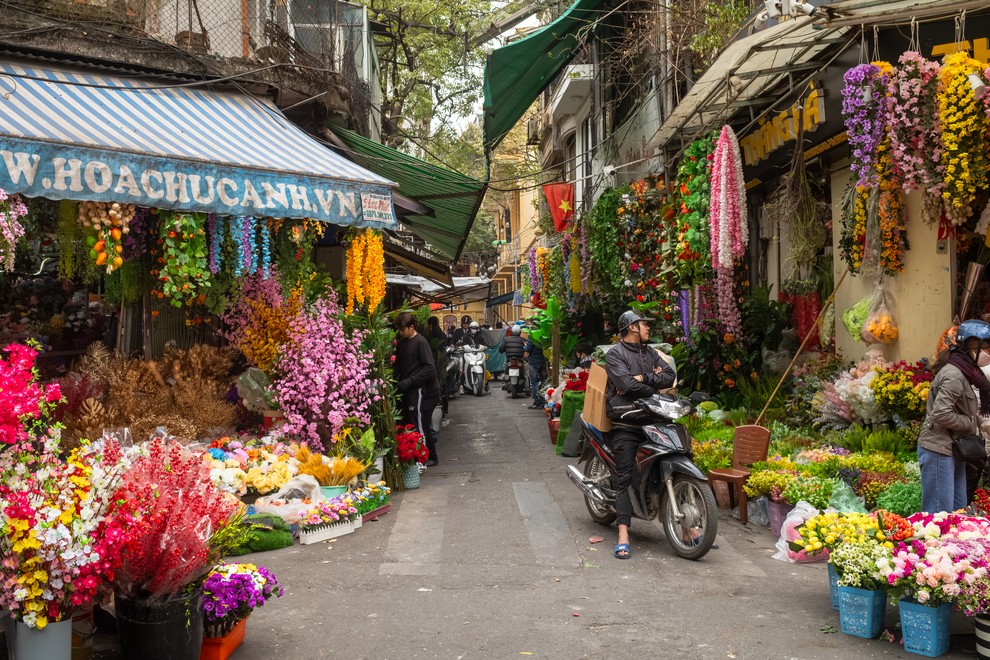
The Old Quarter is the vibrant heart of Hanoi. The narrow alleyways are lined with small shops, street food stalls, cafés and workshops, whilst motorbikes seem to appear from every direction.
Particularly fascinating are the historic 36 streets, each of which was formerly dedicated to specific trades and goods. Even today, many street names are a reminder of this tradition. In between, you’ll constantly come across ancient temples, colonial façades and small courtyards. A stroll through the neighbourhood is particularly worthwhile in the early morning or towards evening, when the temperatures are more pleasant and the city feels especially lively. The area around Dong Xuan Market is a great place to observe local daily life.
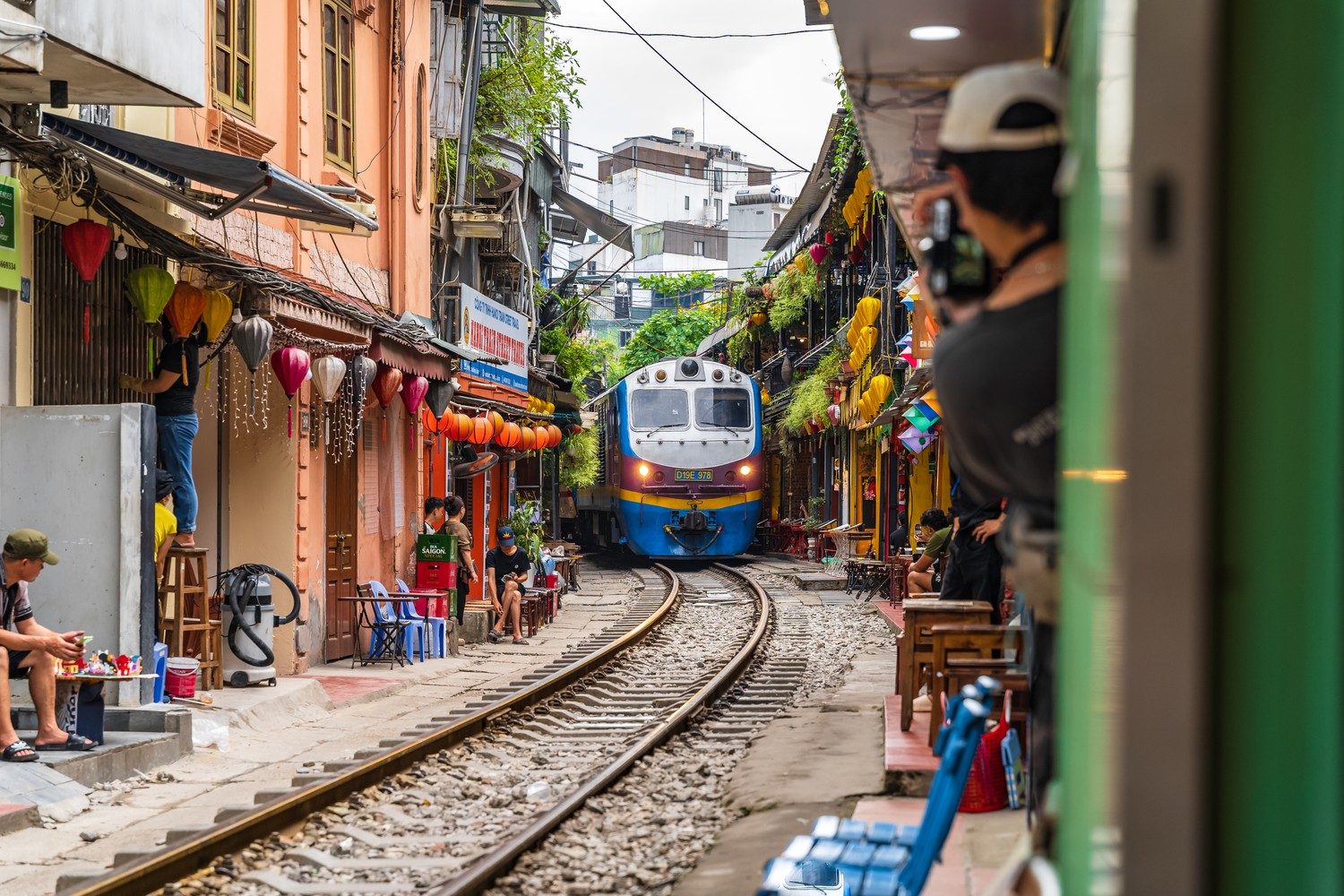
Photo: A train travelling along the narrow Train Street in Hanoi.
Hanoi Train Street is one of the city’s most extraordinary experiences: several times a day, a train passes just a few metres away from small cafés and residential buildings. There are two well-known sections. The northern section near Trần Phú/Phùng Hưng is more strictly regulated and access is sometimes restricted. We therefore recommend the southern section on Lê Duẩn Street, which is easier for visitors to access.
The easiest way is to search for ‘Hanoi 1990s – TrainStreet Coffee’ on Google Maps. It’s best to arrive around 40 minutes before the train if you want to secure a good spot. The train at around 7.20 pm is particularly popular – so it can get quite crowded. Things are a bit less hectic around the time the train passes through, at around 7.45 pm (as of September 2026). However, you should always check the current times again once you’re there.
Important: Make sure you bring enough cash with you. Many of the small cafés along Train Street do not accept credit cards.
Our café recommendations on Train Street
Our tip: Train Street isn’t just a tourist attraction, but first and foremost a residential area. People live and work right next to the tracks. So please respect the local residents, avoid making unnecessary noise, don’t block any entrances, and follow the café staff’s instructions when a train is approaching.
Video: Anthony Bourdain in Hanoi: the full episode of *Parts Unknown*
Hanoi is a city that you really should explore through its food. The best meals aren’t necessarily found in posh restaurants – often they’re in small eateries that have specialised in a single dish for years.
Our restaurant recommendations
Our tips for finding a restaurant
When choosing a restaurant in Hanoi, we don’t rely solely on Google reviews. Very high ratings can sometimes be influenced by discounts or other incentives – it’s often more interesting to see where lots of locals eat. Our personal rule of thumb: if a Vietnamese restaurant offers an extensive international menu, we usually prefer to look elsewhere. The best places often specialise in just a few dishes – sometimes even just one.
And what about coffee?
Don’t leave Hanoi without trying an egg coffee (Cà phê trứng) at least once. This strong Vietnamese coffee, topped with a creamy mixture of egg yolk and condensed milk, is a speciality of the capital. Also a must-try: coconut coffee – coffee with sweet, ice-cold coconut cream.
Our favourites are:
Video: Bát Tràng Pottery Village – where ceramics, craftsmanship and tradition come to life.
If you fancy escaping the hustle and bustle of Hanoi for a few hours, you should plan a trip to Bát Tràng Pottery Village. This traditional pottery village lies around 14 kilometres from the city centre and has been renowned for its pottery for centuries.
Amidst small workshops, pottery shops and winding alleyways, you can watch the craftspeople at work and, in many places, even try your hand at the potter’s wheel. A particularly fascinating stop is the modern Bát Tràng Pottery Museum: the extraordinary architecture alone is a real eye-catcher, whilst inside you can learn more about the history of ceramic art and see both traditional and contemporary works.
Our tip: Allow about half a day – this will give you enough time to explore the village, the market and the museum without the trip feeling rushed.

There are currently no direct flights from Switzerland to Hanoi. However, from Zurich you can reach the Vietnamese capital easily with just one stopover, for example via Istanbul, Doha, Dubai or Bangkok. Connections from Zurich to Hanoi can also be booked via SWISS, although some legs of the journey are operated by partner airlines.
Noi Bai International Airport (HAN) is situated around 27 kilometres from the centre of Hanoi. Depending on traffic, the journey into the city centre takes about an hour. Taxis and ride-hailing services such as Grab are the most convenient option; the Express Bus 86 is a cheaper option. In the Old Quarter, the best way to explore Hanoi is on foot. For longer journeys, we recommend the Grab app. For short distances, GrabBike is often quicker and cheaper – particularly in Hanoi’s heavy traffic.
If you’d like to ride a scooter yourself, bear in mind that the traffic can be very hectic and can quickly become overwhelming for the unaccustomed.
Hanoi is an exceptionally affordable destination by Swiss standards. As a rough guide, 1 CHF is currently worth around 32,000 VND, so 10 CHF is roughly 320,000 VND. The exchange rate can, of course, fluctuate.
For a typical day in Hanoi – excluding flights but including accommodation, meals, coffee, short Grab journeys and one or two admission fees – you should expect to spend around 1,000,000 to 1,800,000 VND per person. That’s roughly CHF 30 to 55. If you’re travelling on a very tight budget, it’ll work out cheaper; with boutique hotels and upmarket restaurants, it can easily cost considerably more.
Typical prices in Hanoi:
Our tip: Food, coffee and short journeys in Hanoi often cost just a few francs. Your choice of accommodation therefore usually has the biggest impact on your travel budget.
Prices: as at September 2026
If you’re visiting Hanoi for the first time, you should spend at least one night in the Old Quarter. That way, you can experience the neighbourhood’s unique atmosphere in the early morning and in the evening, when many day-trippers have already left. Our recommendation: Maison d’Orient: This small boutique hotel is tucked away in a quiet alley near St Joseph’s Cathedral and was designed by a Vietnamese architect. The individually furnished rooms are named after local spices such as cinnamon, ginger and star anise, and feature many details that reflect the style of old Hanoi.
If you prefer a quieter and more elegant atmosphere, the French Quarter is the place for you. Wide boulevards, French-inspired architecture and its proximity to Hoan Kiem Lake make the neighbourhood a lovely alternative to the bustling Old Town. Our recommendation: Conifer Hotel – a small boutique hotel on a quiet street in the French Quarter, just a few steps from the Hanoi Opera House.
A more relaxed alternative is Tây Hồ on West Lake. The neighbourhood lies just outside the historic centre and is particularly suitable if you fancy escaping the hustle and bustle of Hanoi for a while. Our recommendation: Westlake Atelier – a small, unique homestay with just a few rooms and a relaxed atmosphere. Some rooms have a balcony or terrace, and West Lake is within walking distance.
Hanoi can hardly be reduced to a list of sights – the city reveals itself through the senses: the scent of grilled meat wafting from the alleyways, the honking of horns, which after a few days almost becomes part of the city’s soundtrack, and that first sip of egg coffee. Anyone who immerses themselves in this juxtaposition of centuries-old temples, colonial architecture and street food stalls will discover a city that, despite all the hustle and bustle, is surprisingly easy to navigate. Three to four days are enough to get a good first impression.
In the end, what stays with you most is the feeling of simply having gone with the flow – and that’s exactly what makes Hanoi so special.
Hẹn gặp lại, Hà Nội! – See you soon, Hanoi!

© Swiss Bankers 2026


 Compare cards and conditions

