


Important information:
Am 10. April 2024 wurden das Kundenportal sowie der Web-Zugriff auf das Kartenkonto eingestellt. Bitte laden Sie die Swiss Bankers App herunter, um weiterhin uneingeschränkten Zugriff auf alle Dienste zu haben.
Are you a Swiss Bankers sales partner?
Hier geht es zum Partnerportal.
Bologna captivates visitors with its red-brick architecture, culinary delights and authentic charm. This charming university city in the Emilia-Romagna region is an insider’s tip for anyone who loves culture, history and good food. In this guide, you’ll discover the most beautiful sights and the best hidden gems that make Bologna so special.
 30.07.2025
 Eliza
Contents:
Bologna Attraction No. 3: Under the arcades to the Church of San Luca
Bologna Attraction No. 4: Unwinding in the Giardini Margherita
Bologna Attraction No. 5: Market atmosphere at the Mercato delle Erbe
Bologna insider tip no. 2: Viewpoint at San Michele in Bosco
Bologna insider tip no. 3: A trip to the painted artists’ village of Dozza
Bologna Accommodation Tip: Stay in style at Porta San Mamolo
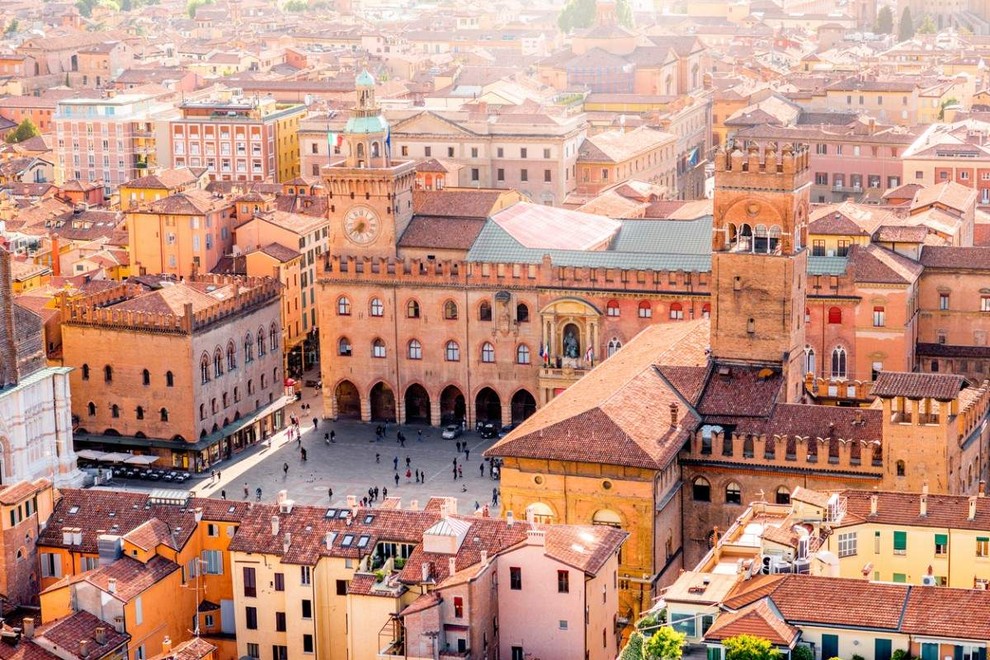

Photo: An ideal starting point for exploring Bologna – Piazza Maggiore, the bustling heart of the old town.
An ideal starting point for exploring Bologna is Piazza Maggiore – the vibrant heart of the old town. This is where life really comes alive: whilst street performers play music or juggle, locals and visitors alike stroll leisurely across the piazza. The cafés all around invite you to linger – whether for a quick espresso or a leisurely lunch whilst watching the colourful hustle and bustle. The imposing Basilica of San Petronio, one of the largest brick churches in the world, impresses with its simple façade and magnificent interior – including ornate frescoes and monumental altars. Anyone interested in astronomy should not miss the meridian line. It was laid out in the 17th century by Giovanni Domenico Cassini and was used to precisely determine the position of the sun throughout the year. These sights are exemplary of the cultural richness of Emilia-Romagna. The region is renowned for its medieval towns, its traditional cuisine and its vibrant arts and music scene – all aspects that come together in Bologna as if under a magnifying glass.

Photo: A close-up of Bologna’s two towers – the Asinelli and the Garisenda – rising proudly and at an angle into the sky.
If you’re feeling brave, climb the Asinelli Tower, the taller of Bologna’s two leaning towers. From the top, you’ll be treated to an unrivalled view over the terracotta-coloured city – a panorama that will take your breath away. The smaller Torre Garisenda leans particularly sharply and was already considered unstable as far back as the Middle Ages. This striking tilt also fascinated Dante Alighieri, who mentioned the tower in his *Divine Comedy*: in a metaphor, he describes how a giant leans as far as the Garisenda – a symbol of threat and instability. Thus, the Leaning Tower became a literary symbol of faltering power and uncertainty. Due to its instability, the Torre Garisenda cannot be visited or climbed today – yet it is still admired daily by countless passers-by at the foot of the two towers.

Photo: With over 40 kilometres of arcades, Bologna is a paradise for shaded strolls – unique in Europe and a UNESCO World Heritage Site since 2021.
With over 40 kilometres of arcades, Bologna is a paradise for shaded strolls – unique in Europe and a UNESCO World Heritage Site since 2021. The so-called ‘portici’ not only provide shelter from the sun and rain, but also shape the cityscape as well as the everyday lives of the people of Bologna. Particularly impressive is the nearly four-kilometre-long, covered walkway leading up to the pilgrimage church of Madonna di San Luca on the Colle della Guardia. The path winds its way through 666 arches – a symbolic number – and connects the city centre with the church perched on a hill. Whether taken at a brisk or leisurely pace, the climb has a meditative quality and is rewarded with a wonderful view over Bologna and the surrounding hills.

Photo: Giardini Margherita, a green oasis in the city – ancient trees, picnic blankets and quiet paths right in the heart of Bologna.
If you’re looking for a break from the hustle and bustle of the city, Giardini Margherita offers a green haven right in the heart of the city. The spacious park was laid out in the English style at the end of the 19th century and, with its mature trees, winding paths and flowering meadows, is a popular retreat. Students out for a jog, yoga groups and families with picnic blankets lend the park a lively yet relaxed atmosphere. A small lake with ducks and the charming Café Le Serre invite you to linger. If you like, you can simply unwind here, read or watch the world go by over an espresso – a perfect place to take a deep breath and recharge your batteries.

Photo: The Mercato delle Erbe in the evening light – market stalls and an aperitif atmosphere beneath a historic glass roof.
The Mercato delle Erbe combines traditional market stalls with modern little bistros and wine bars beneath a historic glass roof. Here you’ll find fresh fruit and vegetables, local specialities such as cheese, pickled artichokes or mortadella, as well as handmade pasta to take away. If you’re looking for an authentic lunch, you can take a seat at one of the small tables and enjoy freshly prepared dishes right there on the spot – from fine antipasti to delicious pasta dishes. In the evening, the hall transforms into a lively meeting place: a glass of wine, a plate of regional delicacies and the buzz of conversation amongst the locals make a visit here an atmospheric experience. The market is extremely popular as a spot for a casual dinner or an aperitif.

Photo: A view through the ‘finestrella’ in Via Piella – the hidden canal reveals a touch of Venetian magic in Bologna.
Less well-known but particularly charming are Bologna’s hidden canals – silent witnesses to the medieval infrastructure that was once used for water supply and trade. Visible in only a few places, their charm is particularly striking in Via Piella. There, at the so-called ‘Finestrella’ – a small window in a building’s wall – you can catch a surprising glimpse of the Canale delle Moline. The narrow waterway winds its way between the buildings and, with its stone-lined banks and reflective façades, is reminiscent of a miniature version of Venice. An almost magical moment that shows just how much hidden beauty Bologna has to offer, even off the beaten track.

Photo: Sunset at San Michele in Bosco – a sweeping view over the rooftops of Bologna to the rolling hills of the Apennines.
A particularly atmospheric spot to watch the sunset is the church of San Michele in Bosco, picturesquely situated on a hill south of the old town. The climb is well worth it: from the small terrace in front of the church, a sweeping view opens up over Bologna’s red-tiled roofs all the way to the Apennines – an unforgettable sight, especially in the evening light. Those who make the journey on foot will be guided through a peaceful park, where ancient trees, birdsong and sweeping views invite you to slow down even as you walk. The church itself, once part of a monastery, is also worth seeing inside and offers a moment of tranquillity far removed from the hustle and bustle of the city.

Photo: Street art in the artists’ village of Dozza – colourful façades and alleyways full of stories.
Just a 35-minute drive south-east of Bologna lies the picturesque village of Dozza – a worthwhile destination for anyone wishing to combine art, history and rural charm. The colourfully painted house facades, designed by international artists, turn the village into a vibrant open-air museum with a fairytale atmosphere. Stroll through the narrow streets, discover numerous enchanting murals and visit the imposing Rocca Sforzesca fortress, which now houses a museum. Another highlight is the Enoteca Regionale dell’Emilia-Romagna in the castle cellar, where you can taste and buy local wines. If you don’t have a car, Dozza is also easily accessible by public transport: regular buses run from Bologna towards Imola, with a connection to Dozza – a relaxed journey for a culturally enriching day trip.

Photo: Homemade tagliatelle al ragù (also known as Bolognese) at a restaurant – culinary love on a plate
The capital of Emilia-Romagna is famous for its unrivalled cuisine – a true paradise for food lovers. First and foremost is the classic tagliatelle al ragù – that hearty pasta dish with slow-cooked meat, which has become known outside Italy as ‘Bolognese sauce’. Other classics include handmade tortellini, often filled with an aromatic mixture of pork, ham and mortadella, or ricotta with fresh herbs, served in a rich meat broth. It’s no coincidence that Bologna is affectionately nicknamed ‘La Grassa’ – ‘the Fat One’ – a nod to the city’s culinary riches. For an authentic experience, a visit to the Trattoria di Via Serra is highly recommended: down-to-earth, family-run, serving seasonal dishes and prepared with plenty of heart. Here, you can really taste the tradition. If you’d like to experience classic cuisine with a contemporary twist, the Restaurant Oltre is the perfect choice. A modern ambience, refined dishes and a creative wine list make it a favourite among curious food lovers.

Photo: The rooms at the Hotel Porta San Mamolo are tastefully furnished and offer a cosy retreat after a long day in the city.
If you’re looking for stylish accommodation in a quiet location, the Hotel Porta San Mamolo is the perfect choice. This small city hotel is situated in a charming residential neighbourhood south of the old town – just a few minutes’ walk from the historic centre, yet pleasantly away from the tourist hustle and bustle. The leafy courtyard, with its lemon trees and cosy breakfast terrace, is a real oasis. The rooms are tastefully furnished – some modern, others classically romantic – and offer a cosy retreat after a long day in the city. The attentive service deserves special mention: personal, warm yet unobtrusive – exactly what you’d hope for from a small city hotel.
Conclusion: Bologna combines history, pleasure and serenity in a wonderfully charming way – with a rhythm all of its own that invites you to linger. Whether strolling beneath centuries-old arcades, gazing out from the venerable towers or sipping an espresso in one of the bustling alleyways: the city tells stories at every turn. Bologna isn’t noisy, but lively. Not intrusive, but welcoming. Anyone who has been there will quickly realise: here you’ll find not only fine cuisine and culture, but also a way of life that stays with you – often for much longer than planned. And that is precisely what makes this city so unforgettable.

© Swiss Bankers 2026


 Compare cards and conditions

