


Important information:
Am 10. April 2024 wurden das Kundenportal sowie der Web-Zugriff auf das Kartenkonto eingestellt. Bitte laden Sie die Swiss Bankers App herunter, um weiterhin uneingeschränkten Zugriff auf alle Dienste zu haben.
Are you a Swiss Bankers sales partner?
Hier geht es zum Partnerportal.
Brittany is a region for anyone who loves the sea but is looking for more than just a traditional beach holiday. Along the coast, rugged cliffs, fine sandy beaches, lighthouses, small harbour towns and historic cities alternate. Dotted amongst them are mysterious menhirs, medieval alleyways, unspoilt villages and landscapes that, depending on the light, look almost as if they’ve been painted. A tour of Brittany reveals just how diverse north-western France is – wild, charming, steeped in history and surprisingly varied.
 13.05.2026
 Miryana
Contents:
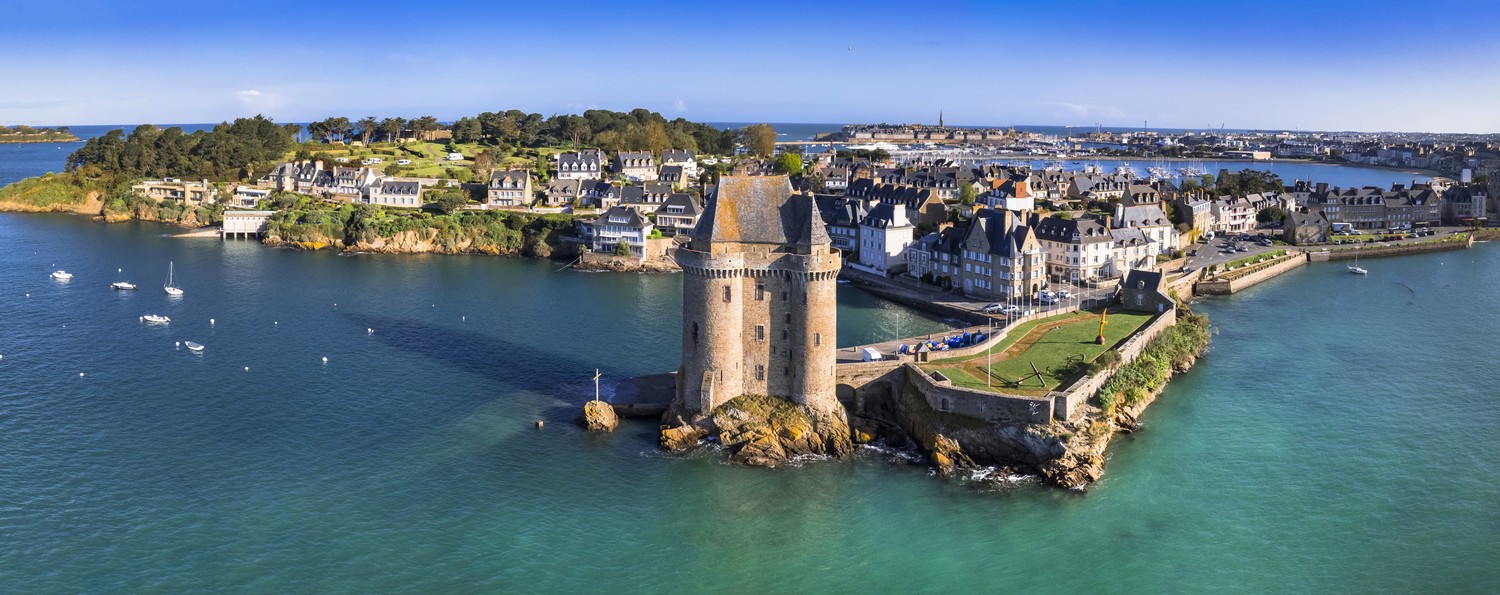
Photo: Brittany from above: a view of the Solidor Tower and the medieval old town of Saint-Malo.
The best way to explore Brittany is on a round trip. Many of the most beautiful places are situated along the coast or a little way out of the major towns, which is why a car is particularly handy. This gives you flexibility and allows you to easily reach smaller villages, secluded beaches, lighthouses and viewpoints.
From Switzerland, you can travel by train via Paris to destinations such as Rennes, Saint-Malo or Brest. If you’re travelling by car, you should allow plenty of time, as Brittany is situated far to the west of France. However, the journey can easily be combined with a stop-off in Normandy, the Loire Valley or Paris.
The tour begins with three places that showcase the charm of Brittany particularly well. Saint-Malo impresses with its fortified old town right by the sea. A stroll along the city walls offers views of the beaches, the harbour and the offshore islands – an atmospheric start to your journey along the Breton coast.
In Cancale, the focus is on culinary delights: the oysters are harvested straight from the bay and can be sampled with ease at the harbour – freshly shucked, with a squeeze of lemon and a view of the sea. Afterwards, it’s well worth taking a detour to the Pointe du Grouin, where the coast reveals its rougher side. Next up is Dinan, a journey back to the Middle Ages. Half-timbered houses, cobbled streets and winding alleys lend the town an almost fairy-tale atmosphere – as if you’ve stepped into a scene from *Beauty and the Beast*.
Our restaurant recommendation: Betton Fils – a lovely spot for anyone who wants to experience Saint-Malo’s culinary delights. If you’re looking for something special, why not plan a detour to Dinard: The Pourquoi Pas restaurant in Castelbrac offers fine dining with views over the Bay of Saint-Malo. Dinan is also well worth a visit for its cuisine – the large market on Place Duguesclin and Place du Champ Clos was named the most beautiful market in Brittany in 2024.
Further along the north coast, Brittany reveals its most impressive side. At Le Gouffre de Plougrescant, mighty granite cliffs, small coves and crashing waves come together. Castel Meur, the little house nestled between two huge rocks, is particularly well known – one of the region’s most unusual photo opportunities.
The landscape becomes even more colourful along the Pink Granite Coast. Between Perros-Guirec, Ploumanac’h and Trégastel, pink-coloured rocks lie right by the sea, appearing pale pink, orange or almost copper-coloured depending on the light. The coastal path near Ploumanac’h is particularly beautiful, where sea views, the lighthouse and the rocky landscape come together perfectly.
After the Pink Granite Coast, the round trip continues westwards. First up is Roscoff, a charming harbour town with historic granite houses, a maritime feel and a relaxed atmosphere. A stroll through the old town reveals small shops, cafés and restaurants, whilst the harbour gives the town a lively yet never hectic feel. If you have a little more time, you can take a trip from Roscoff to Île de Batz – a small island with beaches, gardens and peaceful paths.
Further along the north coast, the landscape becomes rougher and more unspoilt. Meneham, a historic coastal village near Kerlouan, is particularly beautiful. Nestled amongst huge granite rocks, dunes and the sea, thatched-roof houses and old stone walls tell the story of fishermen, customs officers and seaweed gatherers. Today, Meneham is one of those places where you can really get a feel for the authentic spirit of Brittany.
Our recommendations: For Breton crêpes and galettes, Crêperie Ti Saozon is well worth a visit. Those who prefer to eat right by the sea will find Le Surcouf a lovely spot with a maritime atmosphere. The market in Roscoff is also lovely; it takes place on Wednesday mornings on the Quai d’Auxerre opposite the lighthouse – the perfect way to combine regional produce with the harbour atmosphere.
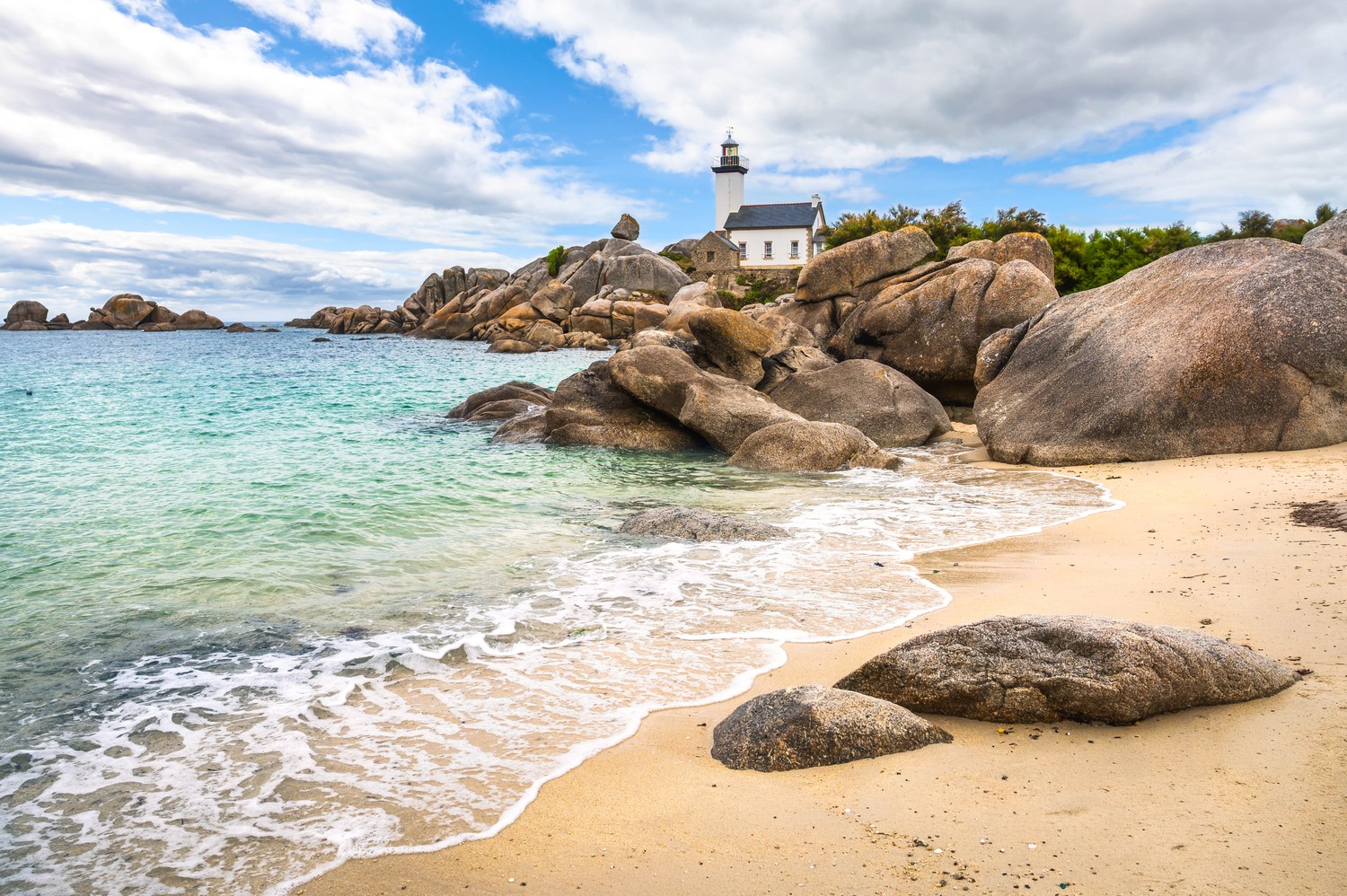
Photo: Pontusval Lighthouse, set amongst a sandy beach, turquoise waters and granite cliffs.
From Meneham, the circular tour continues to Plounéour-Brignogan-Plages, where golden beaches, turquoise waters and the characteristic granite cliffs of Brittany come together. Particularly beautiful is the Phare de Pontusval, a small lighthouse right on the coast that blends perfectly into this maritime landscape.
This stop can easily be combined with visits to other lighthouses along the Route des Phares. In this part of Finistère, Brittany is at its most atmospheric: with wind, a vast horizon, rocky coastlines and ever-changing views of the Atlantic.
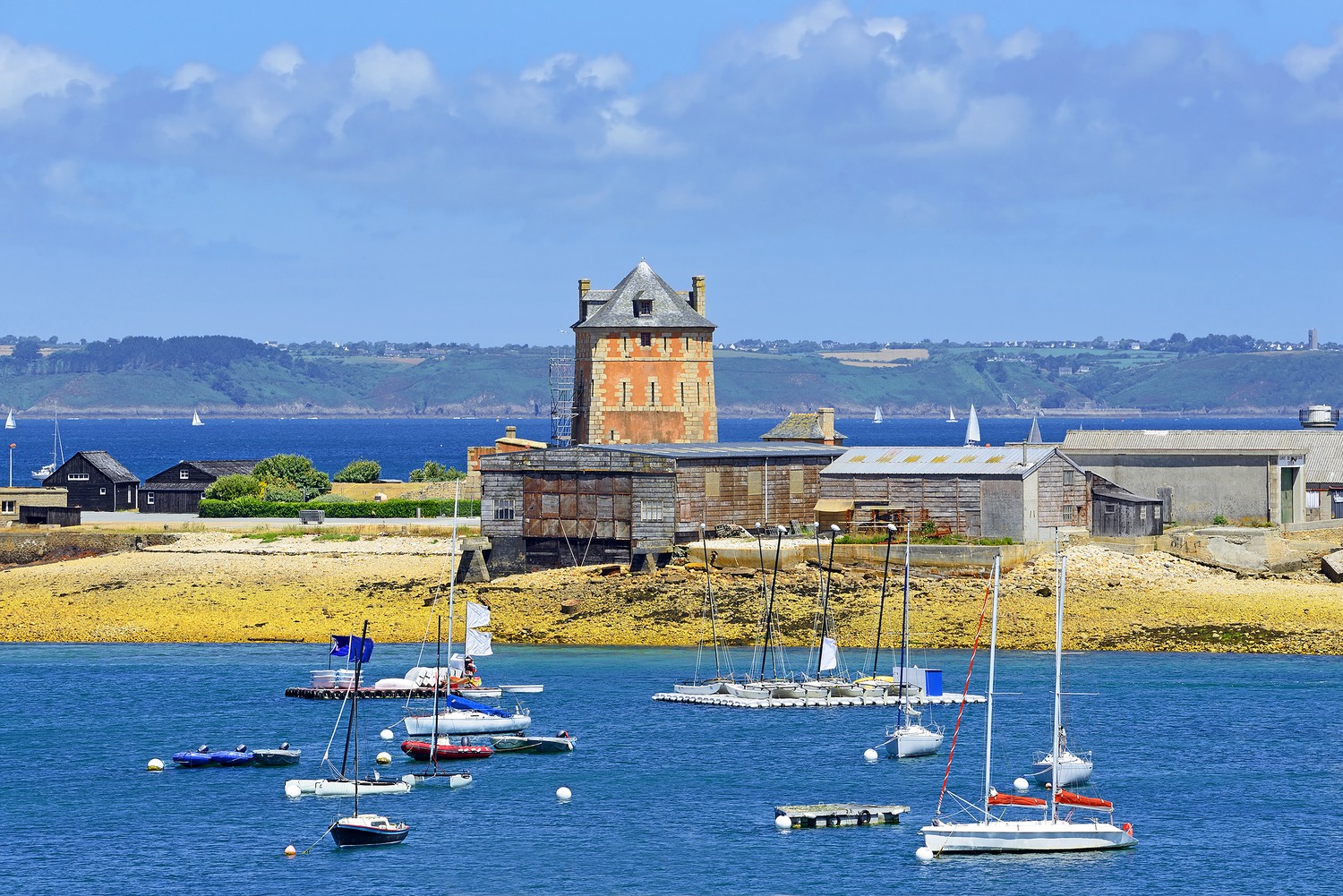
Photo: The Tour Vauban in Camaret-sur-Mer: a historic tower by the harbour overlooking the rugged coast of Brittany.
After exploring the lighthouses and coastal towns in the north, the round trip continues westwards – to where Brittany reveals its wildest and most impressive side. The Crozon Peninsula is home to some of the region’s most spectacular landscapes: steep cliffs, hidden coves, turquoise waters and sweeping views across the Atlantic characterise this stretch. Particularly worth seeing are Camaret-sur-Mer, with its small harbour and the historic Tour Vauban, as well as the nearby Pointe de Pen-Hir. There, the cliffs rise dramatically into the sea, whilst the famous Tas de Pois rock formations lie off the coast. Morgat, with its beach, and the coastal paths around Cap de la Chèvre are also well worth a longer stop.
The Crozon Peninsula is ideal for anyone wishing to experience nature, the sea and stunning landscapes on their tour of Brittany – ideally with plenty of time for walks, photo stops and breaks whilst taking in the view of the Atlantic.
After the rugged landscape of the Crozon Peninsula, the round trip continues to places that reveal a different side to Brittany: historic, cultural and charming. Locronan, one of the region’s most beautiful villages, is particularly worth a visit. With its granite houses, cobbled streets and an almost entirely preserved historic atmosphere, the village looks like a film set.
Further south lies Quimper, one of Brittany’s most important cultural centres. The old town, with its half-timbered houses, small squares and Saint-Corentin Cathedral, is perfect for a leisurely stroll. Breton traditions, arts and crafts, and pottery also play an important role here.
For a maritime contrast, a stop in Douarnenez is well worth it. This port town lies on a wide bay and has close ties to the fishing industry. Between the harbour, the promenade and the sea views, Brittany once again reveals its relaxed, coastal side here.
Further south in Brittany, this round trip combines maritime charm with art history. Concarneau is best known for its Ville Close – a fortified old town situated on a small island in the harbour. With its city walls, narrow streets, restaurants and small shops, the town is a delight to explore on foot. Not far away lies Pont-Aven, a charming artists’ village on the River Aven, made famous by painters such as Paul Gauguin. Galleries, old mills and riverside walks make this a charming stop on the tour of Brittany.
Culinary tip: In Concarneau, it’s well worth stopping for some fresh fish or seafood, ideally with a view of the harbour. In Pont-Aven, Le Jardin des Simples fits in beautifully with the atmosphere of the village: The restaurant specialises in seasonal cuisine using local produce and, weather permitting, offers a small terrace by the water. Pont-Aven is also famous for its Breton butter biscuits and galettes – a lovely souvenir to take home.
To round off the tour, the itinerary takes you to the south of Brittany. Carnac is home to one of the region’s most famous cultural highlights: thousands of prehistoric menhirs stand here in long rows, lending the landscape a mysterious atmosphere. Not far away, the Quiberon Peninsula once again showcases Brittany’s wild side. The Côte Sauvage is particularly impressive, with its cliffs, waves and sweeping views of the Atlantic. Those who prefer a quieter pace will find beautiful beaches and sheltered bays on the other side of the peninsula.
A gentle way to round off the trip is the Gulf of Morbihan with its islands, sailing boats and small harbour towns. Vannes is also particularly lovely; its historic old town, with its half-timbered houses, city walls and harbour charm, reveals yet another side to Brittany.
Culinary tip: In Carnac, it’s well worth a visit to La Poêle à Crêpes – a lovely spot for classic Breton galettes and sweet crêpes after visiting the menhirs.
Video: Teaser 2026 – Festival Interceltique de Lorient 2026.
If you’d like to combine your tour of Brittany with a special occasion, there are several exciting events taking place in 2026. The Fête de la Bretagne takes place from 14 to 24 May 2026 and celebrates Breton culture with concerts, fest-noz, markets and events in various locations. Also in May, Étonnants Voyageurs in Saint-Malo is well worth a visit: this international literature and travel festival takes place from 23 to 25 May 2026. In the summer, Les Vieilles Charrues in Carhaix-Plouguer follows from 16 to 19 July 2026, as well as the Festival Interceltique de Lorient from 31 July to 9 August 2026.
A tour of Brittany reveals just how diverse north-western France is: historic towns, small harbour villages, rugged rocky coasts, lighthouses and tranquil bays are often just a few stops apart.
If you want to remain flexible whilst travelling, you should allow plenty of time – and don’t forget to take out suitable travel insurance. With TravelProtect from Swiss Bankers, you can be well prepared for your holiday and enjoy it with greater peace of mind.

© Swiss Bankers 2026


 Compare cards and conditions

